
"Once more into the breach, dear friends."
11.27.2006
10.31.2006
I just got back from a weekend in Columbia. While it did my heart, soul and body no end of good to be there, it is enormously difficult to be back here in Baltimore. Or rather, back here in Baltimore working in the place I work.
I seem, in my short life, to have a knack for not only taking the road less traveled, but also the road most difficult.
As I sit here with a cup of tea, in the early morning light, preparing to leave in a little less than half an hour – a lesson plan still to be printed, a bag to be packed, hair to be put up and shoes put on – I feel a resistance in my very muscles. While it is typical that I carry all my stress in my shoulders, I’ve never felt such a visceral reaction in my whole body to my present situation. My stomach knots uncomfortably, my entire upper body tenses its muscles.
In the time I’ve been here, I’ve had people encourage me to quit, and people encourage me to stay. And while I won’t say which route I prefer, I know that for better or for worse there are about 45 fourth graders who may not think me the best teacher, but expect to see me at the front of their classroom each day.
Thoughts to be continued…for now I’ve got to get to school, God go with me now as always.
10.09.2006
Third Post from the Coast
Things I used to say on a daily basis:
Would you like to grab some coffee?
I'm reporting/working on this story...
When is my deadline?
This is your deadline...
Yes I have read that interesting article/essay/book and would like to discuss it with you over a cup of coffee.
Sure, I can take that story.
Hi, my name is ... and I'm a reporter with ...
Things I say now on a daily basis:
Your do-now is on the board.
I've got my timer running - it's up to you to earn your Charlie time.
Make a good choice*
Your name is now on my board.
Wow,I love how (student name) is doing their work - they need a sticker - who else is going to get a sticker.
Don't poke me - do I poke you?
Stop touching each other - everyone's hands are at their side.
You can tell me how you're supposed to behave, now you need to show me.
* I say "make a good choice" about 20,000 times a day. Talk about being a broken record.
10.07.2006
Second Post from the Coast
I don’t feel as thought I have anything to write, or to say. As often as I have tried to come up with words to speak, I find that they lack. Miss the mark. Fail the reality.
I have words, but they do not come together in communication.
Complacency Catch-22 Misplaced Perseverence Lost Seen Seen Watched
Witnessed
Illiteracy Ill will Meanness. Plain meanness. Prayer
Prayer Love Predicate Predicated
Decision Choice Communication Fist
Angry fist Child’s angry fist Child’s anger Confusion Disillusion Sorrow Compassion Shoes.
Sympathetic Shoes
Shoes.
Up down Wrong direction
Cleaning Ignorance If I can keep my head, Mr. Kipling.
Stop. Just Stop. Make a choice. A good choice. Before I make it for you.
I’ll wait.
I’m waiting.
I am waiting for you to close your book, clear off your desk – not even a binder, your pencils are down. I’m waiting for you to close your book, put the drawing away, stop writing that note before it becomes mine. I am waiting for your attention on the count of three.
Use your brains, before your fists. I know you’re not listening because your fists are still balled up, you are still frowning, your actions speak so much louder than your words.
Make a choice, it’s up to you. We can all make good choices.
I like that choice. I like that choice, too.
I’ll wait. I’m waiting.
I am waiting for the culture at large to stop making the choices for my students before my students can make them for themselves.
I am waiting. I will wait.
7.16.2006
The First Post from the East Coast
I stood on the top of the stairwell in Temple University’s 1300 Residence Hall, where I could see the fireworks all over the city, and past Philadelphia into New Jersey. The East Coast: a place that seemed nearly fictional to me, that I had never been and only read about it school books. I am on the East Coast now, in places I have only read about in books.
I’ve never watched fireworks without the benefit of family or friends. I’ve never spent the Fourth anywhere but Texas or Missouri. Until a few weeks ago. Out here in the East.
One of the last papers I had to write for a class in London was on the topic of what it means to be an American in a foreign culture. I came across the paper a few weeks ago. I had forgotten what I had written, but I believe it was the seed of the reason that I found myself sans family or friends or familiar faces on the Fourth.
It was shortly after the 2004 presidential election; I watched my country from across an ocean. I wrote about the obstacles in front of our nation. I wrote that to be an American in a foreign culture, for me in that one moment, meant that I was going home to work toward making my country better.
I don’t think of myself as particularly patriotic.
I don’t have an American flag affixed to my car or to any article of clothing.
Ditto for a yellow ribbon.
But I have listened to two of my English colleagues express their gratitude to America for aiding their country in a war fought far too long ago for me to feel any great connection to it.
And I have lain under perfect skies and watched stars fall over the Midwest.
Thrown rocks into the Mississippi River.
Stood in the Gulf of Mexico.
Rafted down the Klamath River in Northern California.
Winded my way through Idaho and Eastern Washington.
Driven through the Five Nations of Oklahoma more times than I can count.
Watched two bear cubs scamper across a field in Alaska where the sun refuses to set in the summer.
Dipped my toe in Wolf Creek at Wolf Creek Pass in Colorado.
Made my way through the deep South of Louisiana, Mississippi, Alabama and Georgia, where they make sweet banana pudding and wave confederate flags as though nothing were out of the ordinary.
I have eaten in a pretty good little Mexican restaurant in Southern Michigan.
And longed for the Piney Woods of East Texas, basked in the Hill Country and stretched out in Texas’ northern plains.
I’ve seen a lot of this country.
I know it not.
The America I know is one where I have both the liberty and luxury to see these things.
The students I am will teach this fall will very likely never have been outside the Baltimore City limits, nor even out of their neighborhoods. Their America is one of projects and poverty. The students I am teaching this summer are nearly in the same boat, except that some of my students this summer have traveled to Puerto Rico where they have grandparents and aunts and uncles.
For the past two weeks I’ve stepped into a classroom full of first graders who look at me with expectant eyes. I cringe if they sit on the floor, because I know that I’ve swept mouse droppings off of it before they got there. I watch them sweat and fan themselves because the air conditioning is broken, and then I give thanks because I have colleagues who are teaching in schools where there is no air conditioning to be broken.
On the hottest days, despite the students’ valiant efforts they tell me they are hot and tired and hungry. I tell them that we are about to go to Boston during the read aloud because we are reading Make way for Ducklings. We’re not here in old, hot Philadelphia anymore I say. They lean forward. We’re in Boston, a city north of here, in the fall and it is cool and leaves are falling off the trees. We’re in Boston and it’s not hot and now we’ll see what’s happening to the ducklings. Slowly their hands which had been fanning their faces drop into their laps and we go to Boston.
The next day I repeat the idea that when we read books we can go anywhere. One of my students raises his hand nonchalant and with a sly smile on his face. I call on him and he says, “Yesterday I went to Boston.” I’m sweating in Philadelphia and it takes me a moment to catch what he is saying with a smile on his face. “Yes,” I exclaim, “High five, you’re thinking a step ahead of me. We did go to Boston yesterday and we are going again today.”
So it is as I walk through my classroom past my students who are hot, past my students who are hungry, past my students who are hurting and sleepy and unlikely to be at school two days in row that I think of my America.
I think of my America as the bus that takes me to school turns onto our street and drives past piles of trash four and five feet high in the road. Like pictures you might see of any other place but America. Pictures that belong to poor countries, but surely not America.
Two Americas: One spoken sweet land of liberty of thee we sing. And the other America: the one we neither sing nor love and yet this other remains a mirror covered waiting to show us what we neglect as a nation while we are off saving the world.
These two Americas clash before my eyes each day.
I find myself again an American in a foreign land.
4.02.2006
I saw the ocean earlier this week, and stocked up enough looking to last me a good bit of time. In the roar of wind and waves is a perfect silence where one can simply be. I was.
***
I wrote words in the sand. Perhaps the best I have ever written. Then I watched the ocean claim them back. But the words were not gone, for they were also written on my heart. The ocean took my words and tickled my feet. Someday it will take back my heart as well.
***
I’ve been told twice this week that I’m going to be a fiction writer. That made me smile. I have actually been writing fiction down here in the Texas quiet. But a lot more discipline in the writing process needs to happen.
***
Blythe is one of the most amazing people I know. She’s a character as big as Texas, which is a good thing since she lives here now. She’s good folks, one of the best I know. Around her there are books and words and ideas and music. They are all moving, all at once and she’ll pick anyone down out of the air for you as soon as she thinks of it. A honky-tonk heart, she always gets the ticket and takes the ride. If you’re lucky enough to be near her, you get to take it too.
***
The longer I stay in Texas the harder it is to leave. I’ll be lonesome when I go, and I won’t lie. Driving to the coast this week, I was kicking myself for not placing the Rio Grande Valley higher on the Teach for America list. But I’ll go to Baltimore. I know that as good as Texas is for me, my feet will get to itching and off I’ll be to see the world. But when I go, I’ll take every glimpse of Texas with me - every sunset and storm, the piney woods and the gulf coast. I’ll store them up in my heart. When I need them, they’ll be there.
Go well. Stay well.
3.10.2006

There is one thing the Missourian does better than any paper in the country and that is their Life stories section. I guess it’s not feasible that papers in larger communities offer free reporter written obituaries, but the Missourian does. And I’ve kept every note I’ve gotten from families who appreciated it. I only mention this because I think my Dad was disappointed today when the St. Louis Post Dispatch wanted to charge him about $3.00 to put a picture in the online guestbook of his baby brother Jesse, who died last week.
The Alsup's, as I know them, are a family of stories and storytellers. This is the most enduring memory I have of my Dad and his brother together. In my mind they are forever on a generous front porch of a tiny house in Barnhart, Missouri, and they are telling always stories of their family. Stories of boxing kangaroos, railroads and ranches and sweet songs through the woods. The thing about an Alsup is that stories never lose anything in the telling, and so in my growing up and the growing up of Jesse's children, I sense that we are surrounded by the half myths created by our fathers.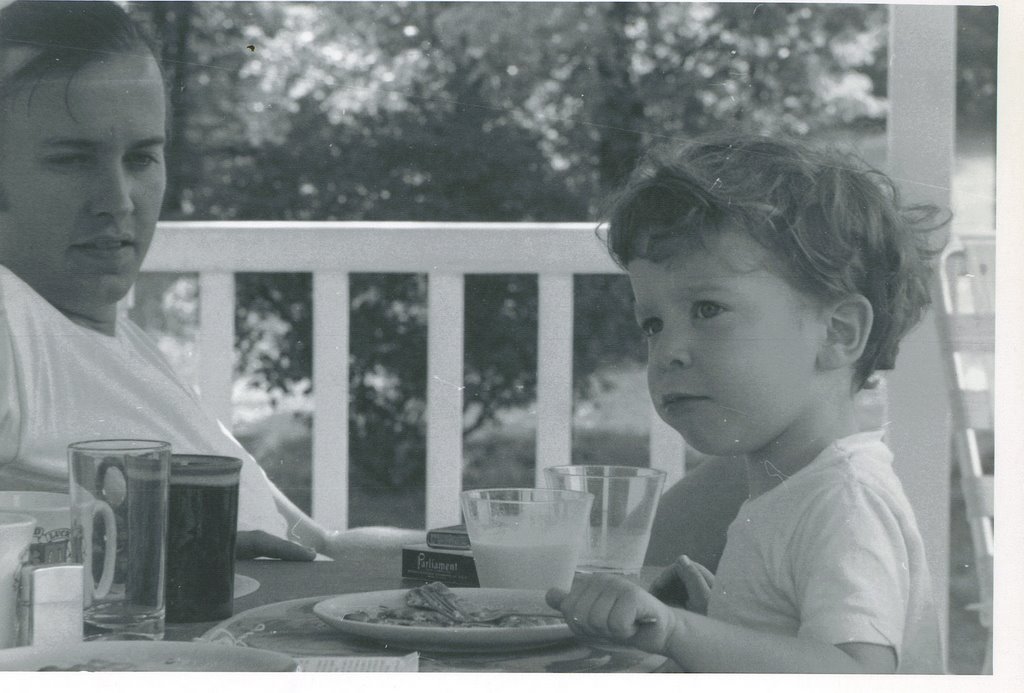
But isn't that true of everyone. There are family legends that grow with time, stories that become touchstones and actions that become tradition. And though I am a teller of stories, in the company of my family I am silent and captive. They are master storytellers, just as my Grandmother was a storyteller. At her feet, my childhood became rich with narrow escapes from mountain lions and bears in Colorado. Her voice could send chills down my spine the way she told about a voice in the cellar who would get Rosie on the first step. The stories would fill up whole vacations. And in the time between visits, the stories came to her youngest grandchildren from her youngest sons.

And I know that beyond this Saturday, when we Alsups will gather for Jesse's memorial service, we will be telling stories. And by the time the stories reach my children, who knows how tall they might have grown?
(Captions: 1. Jesse and Jim Alsup 2. Pricie, Jesse at Olathe Lake 3. Jesse and his nephew, Jimmy 4. Jesse, Pricie, Jim Alsup 1955 5. Jesse, Pricie, Jim 1986
2.15.2006
On Duty
I don't submit this as a treatise on the subject, only some thoughts that have been rolling around in my head in response to my friend Alex's opinion on the matter of duty.
He rejects duty on the basis that it is a form of submission. His belief that the self and the understanding thereof is the ultimate greatest goal of existence leads him to the logical conclusion that duty because it is a form of submission has no place in the life of an individual.
Although I wouldn't classify myself as a "greatest-gooder" I do disagree with the idea that duty has no place in one's life. Individuals submit to a variety of systems on a daily basis. The laws that govern the nation, the traffic signals and rules are simple examles of systems that many submit to on a daily basis.(Copyeditors submit themselves to the dictates of style guides and grammar) These submissions not only contributes to the benefit of everyone, but it also contributes to the well being of the person who submits to it.
I agree that one should not run about willy-nilly following the whims of the masses. However, when the purpose is true and good then what is wrong with submitting to the greater goal? If submitting the self should result in the benefit of others, and also the self, then what is the harm of duty?
When is submission bad? When it strips members of society of their indiviual talents and creativity. Submission is a bad thing when it destroys freedom of thought and existence. There are numerous literary examples of this - Huxely's Brave New World, Orwell's 1984 and Rand's The Fountainhead. Rand is particularly forceful in her arguments about the supremacy of the individual over the general rabble.
I believe that there are causes that are more than "vaporous and transient" to use Alex's words. Helping others when it is in one's power to do so, protecting the environment for future generations by lowering pollution and waste are just a couple of examples.
Admittedly, my decision to teach school next year is largely formed out of my concept of duty.
Do I relinquish my liberties as an individual? No. Do I believe that my government and constitution grant me liberties? Not really. The government and constitution simply acknowledge that I possess them. Were there no government or constitution I would still retain those certain "inalienable rights" endowed to me as a member of the human race.
Finally, I believe that there are causes in which the result of submission surpasses the seeking of the self. Arguably, this submission for the greater good may be seen in the Civil Rights movement, the suffrage movement and the abolitionist movement just to name a few.
2.14.2006
Citius, alius, fortius
On the whole I am not a committed sports fan.
College football, mild interest.
Professional football, not so much.
Baseball, I enjoy a game, I have no idea what all those numbers and letters mean.
I don't follow teams, I never read the sports page.
But for a couple of weeks every couple of years I am a rabid sports enthusiast.
I love the Olympics.
I suppose it starts in 1988, the summer games in Seoul. I don't really remember specific moments, I just have a sense of the brown carpet in our living room and my Mom's committment to the games. Through the years of my growing up are sprinkled the names of olympic greats - Louganis, Lewis, Boitano, Witt, Strugg.
I've never been particularly athletic either, but growing up I learned from Jansen and Blair that when hardwork is added to a dream good things can happen.
I've read the editorials that say the Winter Olympics are boring, but no where else is there such potential for speed, triumph and disaster.
It's not about the athletes who medal, most who go to the games don't "realistically" have a shot. They come to compete against other athletes in their prime, setting aside the politics and struggles of daily life for a brief period.
Because so much is ventured at these games, so much athletically, so much personally, so much in integrity and human spirit, because so much is given great and terrible moments occur. The games present a microcosm of the best and worst in human nature. There has been cheating. Poor sportsmanship. Rigged judging. But as terrible as the bad moments, the great moments are transcendent.
Jesse Owens triumphing in Berlin. An African-American winning not only the race, but a smaller victory against an evil dictator who wanted the games to showcase his master race. And not only Owen's, but Luz Long the German competitor who helped Owen's qualify for the long jump finals by making sure Owen's jumped before the fault line.
2002 when a young American teenager became the first woman to land 7 triple jumps in olympic competition and landed the gold as well.
Abebe Bikila of Ethiopa who won the marathon running barefoot.
Most who go to the games don't medal, but they compete under their flag for the pride of their nation and the joy of being healthy and strong and able to try great physical feats. And this is the olympics. Because no matter what the numbers say there is always the possibility and the hope that for a few minutes an athlete may overtake his or her fellows to see his or her flag raised and anthem sung.
The Olympics in such a compressed time and way show us what is to try great things, to dream, to strive, to push ourselves further than we have ever been. Is that such a bad thing to have in the world?
So I cheer for the Olympics. I follow them. I read the sports pages.
I hope they are not silly, nor outdated because the impetus behind them is good and strong.
We may not need the Olympics, but like art and music, I think they make us better individuals. The hope, the work, the ambition and passion that drive the athletes, those qualities placed in our own lives make us individuals better equipped to live well in a world and build something better for those that follow.
2.09.2006
10 Musings...
1. I think our culture might be in a state of decline, possibly on the way to another dark ages. Discuss.
2. Esquire has certainly been paying a lot of attention to Rhett Miller of Old 97s fame. Fine with me.
3. I told someone today that the problem I had with James Frey's Million Little Pieces was not the fact that he lied, but rather that the writing was not compelling.
4. I've been thinking a great deal about Gatsby and how he reinvented himself. Is Gatsby a good life model?
5. I wonder what the great library at Alexandria was like.
6. Why don't I have ice cream right now?
7. If I took up curling, could I make it to the olympics?
8. Is anyone still reading this drivel?
9. What is the place of duty in one's life? Is duty an outdated idea?
10. These 10 thoughts are so not compelling.
2.07.2006
Come a little closer…
There’s a weird time warp thing on I-35 between Dallas and Austin. Although the drive allegedly takes 3 hours, there is something that makes it feel like five and a half. I believe that the urban sprawl of Dallas and Austin contribute to this, and the flatness in between.
Time warp aside, the way that the plains of north Texas give way to the beginning of the hill country never ceases to be beautiful to me.
I stopped at the Czech Stop and got my usual order of 1 apple and 1 cherry kolache. Spend a quiet moment in memory with my fruit pastries, and got back on the road.
Do you fear this man’s invention that they call atomic power?
So Blythe and I are sharing a pitcher of beer at a dark little dive in Austin when the subject of the Apocalypse comes up, like it does. After solving all the problems the world we headed towards San Marcos for a small concert. Our friend Addie, whose boyfriend’s band was playing in San Marcos, told us about a honky tonk called Giddy Up’s just south of Austin.
There was a woman behind the Giddy Up’s bar who had impossibly long legs and hair that fell past the middle of her back. The regulars called her Blue and she wore cowboy boots with a red and white checked skirt and a black blouse. There was a pool table and folks two-stepping while a band played country tunes up at the front. And so it was here with a warm breeze blowing through the door, and a tall young man two-stepping a short grandma around the room that I wondered how I could possibly be leaving Texas again in the summer.
Like a band of gypsies, we go down the highway...
After introducing Blythe to the wonders of stuffed jalepenos, we set off for San Antone and the Rodeo. We found O’s new digs, met the cat and left on the adventure.
I’ve been to a couple of rodeos and one Spanish bullfight. Now, maybe I’m thinking about this too much, but isn’t it interesting that two cultures developed two different sports that involved angry bulls. Furthermore, if the bull is supposed to symbolize the struggle of life and death, then what does that say about American culture?
The bullfight wears the bull down before the matador comes out vulnerable and alone to face danger. Before the end of the bullfight, the bull has already been wounded multiple times, tired and bleeding it faces the matador.
In bull riding, the bull is healthy and the cowboy just hops on for the ride. The bull doesn’t die at the end. Does that mean that the American attitude is to just take all of life by the proverbial horns and hold on with all you got, while the European attitude is to wait life out and see if you can beat death at the end? I don’t think so, but it’s interesting, no?
And about that war…
While in San Antonio we got into a very forceful discussion about Iraq…tempers and passions and voices were raised. But I believe that we’ve got to keep talking about it, we’ve got to keep thinking about it and we’ve got to keep finding a way to make things better.
Home again
So I returned to Dallas, the laughter of my friends, the satisfaction of good discussion and the Texas wind in my hair.
Just to set the record straight…
Some folks are real picky about who qualifies as a Texan or not. I am a Texan by birth, the rest of my family are Texans by immigration and choice. But for some people, birth is the only valid claim anyone can make to being a Texan. Well, those people are snobby twits and not fit to be called Texans.
All Texans must make a choice at some point of where their home lies; no one chooses to be born here, but one may choose to leave their affections in this place. The original settlers who came from Missouri and other states made a choice to come to this hard and strange land. Texas has always been a place for wanderers, outlaws, idealists and other ragamuffin, vagabond souls. I don’t believe that Texas is an elite club entered only by birth. People get here all sorts of ways and at the end of the day they look back over their shoulders at the pink Texas sunset and call it home.
I believe that those “elite club” Texans are wrong, and shouldn’t call themselves Texans at all if they believe in ideas like “elite” and “clubs,” but they are a picky, bothersome noisy bunch. Thus, I would like to offer my own Texas citizenship in sponsorship for the recent immigrants.
Let it be hereby known that should Blythe, Bree, Aurora, Jason, or Matt ever wish to refer to themselves as Texans they may do so with full approval and endorsement of a native Texan.
1.27.2006
1.04.2006
Let’s come to the table and talk – Seriously folks, I want a discussion here.
In this age of instant information we have been able to watch the families of the West Virginia miners sit vigil, experience the jubilation of a hope fulfilled and descend into grief and anger after the initial report of the miner’s survival was found to be incorrect.
I watched the story unfold on the 24-hour news networks. For around two hours the networks relayed the unconfirmed reports that the miners were alive. One source from the Red Cross said that she first heard the initial report when she was contacted by a media outlet. After hearing this report, she made her way to the mine site.
It is now being reported that no official source relayed the report of survival to the families, but that they received the information from a mine employee via a cell phone.
My questions to journalists and non-journalists are the following:
1)Do journalists bear any responsibility for the information failure that occurred during the mine tragedy?
2)If so, did the pressure to bring the most recent, if not accurate, information to the public, thus keeping pace with their competitors in the news market contribute to the continued relaying of false information?
3)What safeguards could journalists have put in place to guard against the spread of inaccurate information?
4)Many of the on-site reporters spoke of the “euphoria” that swept through the crowd. Do journalists have a responsibility to not be swept up in the enthusiasm? That is, should journalists distance themselves emotionally in order to report cautiously and clearly?
5)Does a reporter’s emotional involvement in a story contribute or lead to shoddy reporting?
6)Journalists were not allowed close to the church or close to the mine site. Should they have had greater access to the site of the story? Would this have made a difference in how the story was reported?
Enough questions? I won’t ask anyone to answer them without answering myself.
1)Yes, I believe the press bears some culpability for the spread of misinformation. In one instance last night, I watched the news networks go from reporting the likely identity of the first miner that was found, to reporting as though it had been confirmed the identity of the miner. It was my impression that as one network reported the likely, but unconfirmed identity of the first miner that the other networks simply “borrowed” the reporting from other media outlets. Eventually, it was reported as coming from the AP even though the niece of the miner was still saying that the identity had not yet been confirmed. It is my impression that this spread of information from network to network happened multiple times last night, despite the lack of official confirmation from the mine company or the governor of the reports of survivors. As one network reported information, other networks seemed to pick it up as well.
2)There is a tremendous race by the news outlets to be the first with information. This is seen quite clearly in the broadcast side of things. Unfortunately, the race to be first in the market with a story sometimes leads to the reporting of inaccurate information. (Such as when Fox News and other outlets called the state of Florida before all the polls were closed in the 2000 election). I believe the race to be first also leads to the great amount of speculation and interpretation that occurs on the news networks in order to maintain continuous coverage on the major stories, often from reporters who are unqualified to comment intelligently on the subject because of a lack of expertise in the matter. The problem with journalists speculating on air or in print is that we tell the public that we report accurate information. Because of our position as information hunter-gatherers the public trusts us to have confirmed our reports with more knowledgeable sources. When we make off- the-cuff comments, stemming from our own opinions we violate that public trust.
3)One of the first things I heard as a reporter was this adage, “If your mother says she loves you, check it out.” There is tremendous value in confirming information from multiple sources possessing expert information. I have heard it proposed this morning that the best way to report this would have been to attribute the report to the families in order to remove the news outlet from the “hook” of inaccurate reporting. To attribute reports to sources is not primarily a way to hedge the news outlet’s bets. Reports should be attributed in order to provide the public with the most accurate information and to demonstrate the sourcing of the story in order to show that the journalists was not making it up out of whole cloth. Had journalists displayed caution and restraint in reporting the story, saying that reports were being heard from family members, though not from official sources as they tried to confirm the story from official sources it would have been better than reporting primarily heavily on the emotion or jubilation of the community. Secondly: Do your own reporting, do your own reporting, do your own reporting. Period. Don’t take your reporting from other journalists or outlets, try and confirm the story yourself. Thirdly, place a higher value on accuracy and truth than on being first with the story. It is good to report quickly, but it is most important that the information be correct.
4)I believe that objectivity is a myth. I believe that when a journalist cuts him or herself off emotionally from a story an important element is lost. A personal connection, an empathy is lost when journalists place themselves completely apart and separate from the rabble of the emotions of the story. News does not happen in a vacuum, journalists become a piece, a sliver of the story despite their best intentions at objectivity. Journalists must acknowledge their own biases, experiences and limitations in approaching a story. Although I think that complete objectivity is unattainable, accuracy and truthfulness is completely within the journalist’s grasp. We must report the facts, not our opinions and speculations. As journalists, we stand in for the public, we are the self-appointed eyes and ears of the nation. We have an obligation and a duty to report what we witness, not what we believe or hope or desire. We are human beings and fallible, prone to emotion and hope. But in the public trust of journalism, emotion must be tempered with wisdom and discretion.
5)Sometimes, yes. Emotion can lead to bad reporting. I feel comfortable saying that every journalist on that scene wanted a happy ending. Wanted to be able to report a success. I’m not sure that I would have reported the story any differently than they did last night. It is a sad example of reporting the story that was wanted, rather than finding the story that existed.
6)My understanding of the access allowed to the journalists is incomplete, but it seems as though they were some distance from where the events were occurring. There are many reasons to keep journalists out of a specific area – to control the spread of information, to protect the safety of both journalists and rescue workers (the thought being that valuable resources could be used to keep bumbling reporters from hurting themselves or getting in the way.) But, journalists are professionals, with a specific and important job to do. If it were possible that a small press corps could have been placed closer to the scene, I believe it might have helped the real story – that reports had not been confirmed, that reports were false – get to the public faster.
The question of whether the news media “blew the story” has just been posed by Fox News, nearly 12 hours after their correspondent broke the incorrect information. It has taken 12 hours for the news media to even acknowledge that it may have some responsibility for the misinformation.
Journalism proclaims itself the watchdog of democracy, journalists find themselves in a position of authority. But that authority is lost, the public trust is breached when we report false and inaccurate information. I heard an interview from a scholar of journalism who said that journalists may see themselves as a type of priest in a sacred order. I am no priest. I don’t believe that journalism is an inherently precious or sacred thing. If anything gives a noble air to journalism, if anything hallows the newsroom it is the communities we serve. It is the trust placed in daily newspapers. The promise that journalists will provide accurate information that will help our communities.
I would like to close with a few words of the journalist’s creed penned by Walter Williams.
…I believe that the public journal is a public trust; that all connected with it are, to the full measure of their responsibility, trustees for the public; that acceptance of a lesser service than the public service is a betrayal of this trust.
I believe that clear thinking and clear statement, accuracy and fairness are fundamental to good journalism.
Journalism has no internal board of standards, no governing body to hand down ethics and instructions. All we have is the trust that may be placed in our word. Any journalist, any news outlet, is only as good as their name. And the title of journalist is one that presupposes a commitment to truth and accuracy.
P.S. Just now, in a story on Fox News that was discussing media culpability, a judge acting as a commentator said that we may see the first instances of an emotional distress suit against media outlets as a result of this story. The journalists reply was “We didn’t start the rumor.”
To report inaccurately is offensive, but to not take full responsibility for it is inexcusable. By not owning up to factual errors, journalists further violate the public trust.
12.31.2005
I heard an interview with a writer. When asked to talk about pivotal moments in his life, he said he didn’t really look back at his past because he was too busy looking forward. But ignored or not, the past trails my heels like a shadow. I can’t shake it, and really I don’t want to put it down. The stories and dust ridden memories remind me of who I am.
Tomorrow, the only thing that will be different in my life is the number on the calendar. But a year from now I will be different, a thousand different moments and memories will have shaped me up a little more into the person I am becoming.
In the past year I’ve stood next to a new grave, I’ve danced with a friend at her wedding. I’ve graduated from college and eschewed, at least for two years, my chosen profession of journalism in favor of teaching in a school where kids are struggling to learn. What should I say - That I laughed and cried this past year, that sometimes I did both? That’s life. Everyone on the face of the planet did those things in 2005.
So now we turn our faces to a new year that will come in the night. Maybe we stay up to watch the year turn because we are afraid the New Year will sweep away our memories and give us a clean slate if we aren’t awake to hold on to our remembers. Without our scribbles from all the years prior, how will we know where we are and where we have been?
I turn my face to the coming year and I can promise one thing in complete confidence. I will laugh and cry, sometimes I might do both. I can promise another thing too: at the end of 2006 I’ll turn another page in this story and what is to be written on that page won’t make sense without the ones that came before.
Happy New Year. It’s a prayer, really. A wish, a hope offered up, laid on someone’s shoulders in love and protection. It is a hope that one will find comrades to stand with in laughter and in not-laughter.
It’s the end of another year and I’m off to see the world, but not alone. For at my shoulder stand the people who carry my past, my stories, and so carry my future as well. Happy New Year to you all.
12.09.2005
I savor the action of opening or closing a book, I don't know why. They are actions in which I take deliberate measure.
Tonight I finished what is essentially the last paper of my college career. In the past four and a half years, I've written on philosophy, music history, all sorts of literature, journalism ethics and British culture. And tonight was just an assignment like any other.
When I hit save and closed the document I reached down towards the text I was writing about. I removed the bookmark I had been using, set my pen off to the side and gently closed it's front cover and lay a paperweight on it so that the cover would lay flat and not half open. It's an action I've repeated so many times that I do it without thinking. As I sat back I smiled, realizing that I was done.
I closed the book. I finished my last paper. I made it through.
11.03.2005
Poor Absalom and other musings from Bag End:
My roommate has the patience of a saint – particularly evidenced by the fact that she is still talking to me after I subjected her to a plot summary of Faulkner’s Absalom, Absalom. Forcing someone through Faulkner is just plain mean.
Incidentally, my southern literature professor said I was an exception. I would like to think he meant that my genius was obvious, but I think he meant that the fact that this is my second time through Absalom makes me seem like a freakish literary loser to the rest of the class, who feels that once is one too many times to read this book.
“Where did you read the first time?” he asked.
“My mom gave it to me for Christmas.” I said.
“She gave you an oppressive text for Christmas?” he said and laughed.
Then he asked why I came back to it.
“Once there was a summer of wisteria.” I said. “It’s beautiful.”
***
I went to the contributing writer’s meeting yesterday, and found the doubt I’ve been feeling about the profession of journalism increasing. The editor of Vox pitched a profile on a yet-to-be-determined person who is in a severe state of “arrested development.” As he put it, someone who still buys comic books, is working on their fourth college degree at age 36, someone who still drinks with the undergrads at Harpos. Someone who refuses to grow up. Now the way he said these things made it sound an awful lot like they were just looking for someone to make a fool of, someone that the entire readership could laugh at together.
It’s not the first time I’ve gotten the sense that some of the people in this journalism school would rather tear people down just to laugh at them than to help them out.
It just about made me cry, just broke my heart to hear a story pitched that sounds so mean.
***
I’m idealistic in a lot of ways, and I dig that some people think that’s not a great way to be, but at the end of the day I want to know that I helped, that I tried to make things a little better. Somebody’s got to work towards that goal, right? So why shouldn’t it be me?
***
My desk has been broken since the day I inherited it – the keyboard drawer thing has never been right. That in mind I’ve taken to jotting notes on the actual desk with my fine-tipped Sharpie pen.
Here are some of them:
Cast your fate to the wind; see what the wind brings back.
When I say I am sorry I mean that I am not yet the person I wish to be.
Chase the greater dream. The one that seems just out of reach. The one that will neither let itself be caught nor abandoned.
***
We are such dreamers. And so often disappointed.
10.18.2005
10.12.2005
Did I make the right decision? (Audience response encouraged)
Today was a first for me, about 20 minutes ago I turned down a story after an editor offered it to me. My name had been suggested by the contributing writing coach. I have never turned down a story that was offered to me before, so I'm kind of questioning my choice.
The story was a Scene and Heard - a short slice of life piece in the front of the book. It's one of my favorite sections. The assignment was to go to the Cat Fanciers
Association show next weekend and find a kitty-cat tale for the magazine. I would love to do this story, but as I've mentioned before on this blog - I'm allergic to cats. So the idea of going into an show room full of cat dander and fur just didn't seem like a good idea. Particularly when I can't even spend more than 10 minutes in Patrick's apartment (his roommates have cats) without sneezing. Right. Putting myself in the middle of the flying fur would have been a bad idea. I would have been sneezing all over cats and their owners and that's no story.
Some of my most miserable childhood memories involve cats - my eyes swollen shut, incessant sneezing. As a child, I blamed the cats - I didn't do anything to them, I just wanted to pet them. Originally I liked cats. But I couldn't be around them.
To this day, I am uncomfortable around cats. I don't even like them to touch me. My favorite thing to say to a cat is "Go'on. Git."
Still there's a part of me that would really love to do the story. I mean a cat show - what even happens at a cat show? And the Maine Coon cat breed will be there - those things get to be 20 pounds.
Alas. Did I make the right decision?
Subscribe to:
Posts (Atom)
